Available for robotics & aerospace roles
Mechanical Engineer · Robotics · Controls · Hardware
I build machines that have to survive the real world.
I work in robotics and controls, and I don't stop at the CAD model. A design isn't finished until it flies, drives, or survives the test stand. Right now that means a six-rotor drone I'm developing in Prof. Bewley's lab at UC San Diego, and a self-driving car that surveys terrain on its own.
I'm a Mechanical Engineering graduate student at UC San Diego, focused on robotics, controls, and hardware. My work covers the full build cycle: CAD and CNC machining, control design in MATLAB, and the software that ties a system together.
Before UCSD I spent two years at Apple's Elk Grove facility supporting new-product builds across 500+ SKUs, and completed a student-engineer internship with the County of Sacramento, benchmarking energy use across 120+ buildings. Today I'm a graduate researcher in Prof. Thomas Bewley's lab, where I design, build, and fly a fully-actuated hexacopter. This summer I also built a self-driving car that surveys vegetation on its own and reports what it finds.
None of these happened in isolation. Each project made me hungry for a bigger one, from a single machined part to an aircraft with six motors and a mind of its own. Click any step and it opens right here: the story, the build, and the photos to prove it.

A working aluminum cannon, turned and milled in the machine shop.

A competition robot built from scratch that took first place.

Fatigue-life data pipelines in an advanced-materials lab.

Numerical methods from scratch, then a full AI trading system.

An automated neuroscience rig. I wrote the software that runs it.

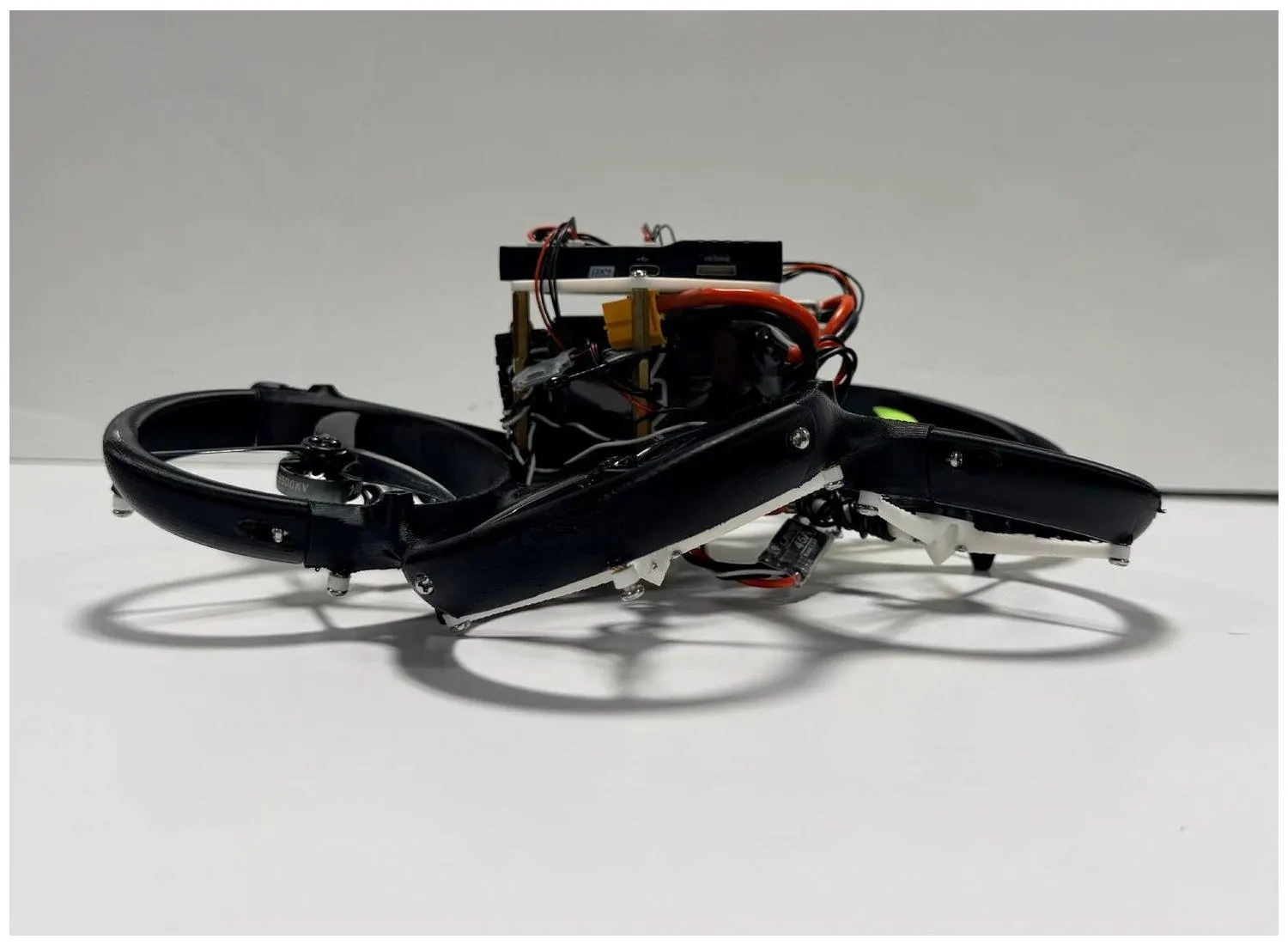
A fully-actuated hexacopter taken from CAD to flight-ready.

A self-driving car that surveys vegetation and writes its own report.
Designing and flying a fully-actuated fixed-tilt hexacopter: CAD, fabrication, propulsion testing, and 6-DoF flight control.
MATLAB metrology pipelines, machined test fixtures, and fatigue testing feeding fatigue-life models for AM steels.
Benchmarked energy use across 120+ county buildings, scored efficiency, and flagged low performers for audit and reduction.
Two years inside new-product builds: kitted inventory across 500+ SKUs, flashed and tested production units, and cleared supply constraints to keep lines moving.
A few shots of the builds and the work behind them, including how the drone went from a bare frame to flight-ready. Tap any photo to enlarge it.


A team machine-shop build, and where I learned to actually make parts: a working scale cannon turned and milled from aluminum. We modeled every piece in SolidWorks, drew dimensioned and toleranced engineering drawings, then cut them on a manual lathe, a Tormach lathe, and Haas CNC mills before assembling and polishing the finished cannon.


Led mechanical design on a small team: built the chassis and drivetrain from scratch and iterated through three revisions to take first place in the competition. Everything was designed in CAD, 3D-printed and laser-cut, and rebuilt as fast as testing broke it.


Turning raw optical metrology into fatigue-life data for additively-manufactured steels. I built MATLAB pipelines that quantify defect fractions and surface roughness, designed and machined test fixtures, and ran fatigue tests across material variants while keeping the datasets clean and traceable.

A from-scratch set of the core numerical methods in MATLAB: ODE solvers (Euler and my own RK45), a shooting method, numerical integration (trapezoid and midpoint), finite-difference derivatives, and root finding (bisection and fixed-point iteration).
A personal deep-dive into modern software and AI tooling: an automated trading research system that ingests public "smart money" signals (congressional trades, insider filings, 13F whales, activist positions), scores them, and paper-trades a risk-gated portfolio end to end, with backtesting behind every rule. The repo is private since it trades a live account, but I'm happy to walk through the architecture.

My senior capstone for a UCSD neuroscience lab: an automated touchscreen rig that trains group-housed mice on the 5-choice task. I handled the software side of it, which meant an operator dashboard (HTML/CSS/JS) with live per-mouse metrics, a Python/Flask "brain" that runs through every training stage in order, and the data-logging plus the Wi-Fi/MQTT link to the hardware.


A six-rotor drone whose rotors sit at fixed angles, so it can move in all six directions without a gimbal. It's meant for tracking a target and searching tight spaces like tunnels. I took it from CAD to a flight-ready build: the SolidWorks design, a 3D-printed monocoque airframe, thrust-stand testing of ducted vs. un-ducted props, and a 6-DoF flight controller that I tune in MATLAB and test in our motion-capture room.


A 1/10-scale car that surveys vegetation on its own. Press one button in a browser and it brings up centimetre-accurate GPS, drives a saved route with no driver, identifies trees, shrubs, and people from its camera as it moves, stops itself when the loop closes, and writes the report.
The detection runs on the car, on a 26 TOPS accelerator, not on a laptop and not in the cloud. I trained the model by having a large vision model label our own footage, then distilling that into a small one built for the chip. On hardware it holds 0.735 mAP50 at 41.8 frames per second, roughly forty times what the same model managed on the onboard CPU.


